The mirror
Blind Willow, Sleeping WomanThe mirror is an apparent full-length mirror in a school hallway that reflects a night watchman as a hostile double, then proves never to have existed. Its impossible appearance and disappearance make the episode a confrontation not with a ghost or an external enemy, but with the watchman’s own self: afterward, he keeps no mirrors in his house and remembers the night as evidence that the self can be the most frightening thing in the world.
Appearance in the School
During a night shift, the watchman is making his rounds in a school as a typhoon approaches. The building seems ordinary, but the storm has blotted out the moon, leaving the first-floor hallway pitch black. He hurries toward the janitor’s room, his flashlight illuminating the green linoleum and the darkness ahead. Passing the school entrance, midway down the corridor, he thinks he sees something beside the shoe-storage shelf. He breaks into a sweat and turns toward it, gripping the wooden sword he has brought with him.
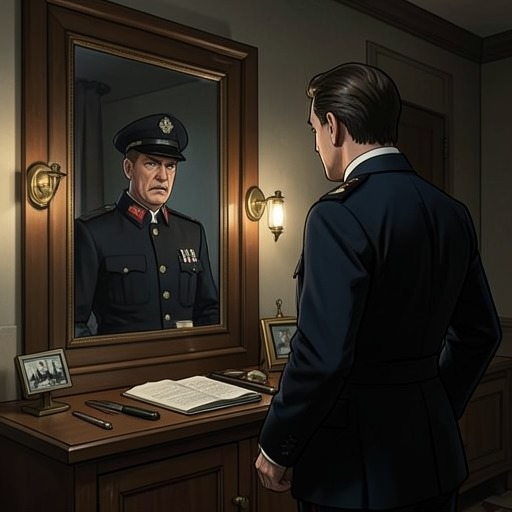
The beam reveals what looks like a newly installed, full-length mirror. The watchman has never seen it there before and supposes it must have been put in since the previous night. Relieved to find an ordinary explanation for the shape in the dark, he feels foolish for being startled. He sets down his flashlight, lights a cigarette, and takes a few puffs. A faint streetlight reaches the mirror through a window; behind him, the swimming-pool gate bangs in the wind. In this moment, the mirror seems to belong to the mundane school setting, a practical surface newly noticed amid the storm.
The Reflection Turns Hostile
The watchman then notices that the reflection is not simply an image of himself. It looks exactly like him outwardly, but feels like another version of him, one that should never have existed. What he understands most clearly is the figure’s hatred: he perceives it as an immense, undiminishable loathing, compared to an iceberg floating in a dark sea. The mirror does not reveal a different face; its terror comes from the familiar face seeming to contain an alien self.
For a time, he and the reflection stare at each other. His cigarette falls from his fingers, and the cigarette in the mirror appears to fall as well. The watchman feels unable to move. Then the reflected figure touches its chin and slowly moves its fingertips up its face. The watchman realizes that his own hand is making the same movement. The apparent mirror image has become a threat to his agency: rather than merely copying him, it seems to be taking control.
The Mirror’s Destruction and Disappearance
Summoning his last strength, the watchman roars, breaks free of his paralysis, and brings down his kendo sword on the mirror. He hears glass shatter but does not look back. He races to his room, locks the door, and leaps under the covers. He worries about the cigarette butt left on the floor, but cannot make himself return. All night, the wind howls and the pool gate continues to bang; the storm’s sounds keep the encounter in the night watchman’s mind even after he has fled.
By morning the typhoon has passed. At the entrance, he finds the cigarette butt and wooden sword, but no glass and no mirror. He then makes explicit the reversal that gives the object its defining status: there never was a mirror there. The ordinary evidence left behind confirms that he went to the entrance and struck something he experienced as real, while the mirror itself has no place in the daylight scene. The narration identifies what he saw not as a ghost, but as himself.
Aftermath and Significance
The mirror’s disappearance does not erase the encounter. The watchman says he can never forget how terrified he was, and the experience leaves a practical consequence: he has no mirrors in his house and has had to learn to shave without one. The object that first seems to offer a reassuring, recognizable image instead makes self-recognition unstable, turning the familiar face into the source of danger.
The revelation that the mirror never existed also makes the episode’s central image a problem of perception rather than a supernatural object with an established physical presence. The watchman’s own formulation is that the most frightening thing in the world is the self. The mirror’s brief, impossible presence gives that claim its force: the double appears to be an enemy, but the story denies the comfort of locating the threat outside the person who sees it.